
5 High-Functioning Anxiety Habits You Probably Thought Were Normal
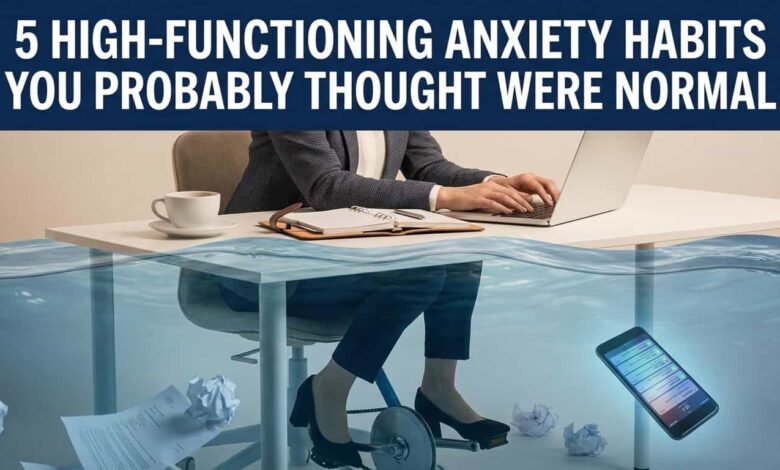
You don’t look anxious. You look like the most organized person in the room. You reply to emails in seconds, you never miss a deadline, and you’ve already mapped out three escape routes for a party you haven’t even decided to attend yet.
But here’s the truth: your “productivity” might actually be a trauma response.
High-functioning anxiety is sneaky. It doesn’t stop you from living your life; it just makes you exhausted while doing it. Because it hides behind traits society praises—like being detail-oriented or reliable—it’s easy to assume you’re just “wired this way.”
You’re not. You’re coping. Here are the 5 habits that feel normal but are actually your nervous system screaming for a break.
1. The “Pre-Mortem” Overthinking Spiral
You don’t just plan for the future; you plan for the apocalypse.
Before sending a simple text, you draft it in your notes app. Before a meeting, you run through every possible question you could be asked, rehearsing answers for scenarios that have a 0.01% chance of happening. You call it “being prepared,” but it’s actually anticipatory anxiety.
The Tell-Tale Sign:
You feel relief only when you’ve mentally solved a problem that doesn’t exist yet.
Why it’s anxiety:
Your brain is trying to control the future to feel safe. But because the future is uncontrollable, you stay stuck in a loop of “what ifs” that drains your mental bandwidth for the present moment.
The Shift:
Ask yourself: “Am I solving a problem, or am I just rehearsing fear?” If you can’t take action on it right now, it’s just noise.
2. The “Apology Reflex” (For Existing)
Someone bumps into you at the grocery store. You say, “Sorry!”
The waiter brings you the wrong order. You say, “Sorry to bother you…”
You start emails with “Sorry to bother you” even when you are literally emailing someone to do their job.
High-functioning anxiety often manifests as over-responsibility. You feel personally accountable for everyone else’s comfort. This isn’t politeness; it’s a chronic fear of being perceived as difficult or “too much.”
The Tell-Tale Sign:
You physically wince when you have to ask for a refund or send back a meal, even if it’s inedible.
The Shift:
Replace “I’m sorry” with “Thank you.”
-
Instead of: “Sorry I’m late.”
-
Try: “Thank you for waiting.”
It validates the other person without declaring yourself guilty.
3. Toxic Productivity (The Inability to Rest)
You haven’t watched a movie without also folding laundry or scrolling on your phone in years.
Sitting still feels physically uncomfortable. If you have a “lazy Sunday,” you feel a wave of dread by 3 PM, convinced you’ve wasted the day and are now behind on life. You don’t relax; you just recharge enough to work again.
The Tell-Tale Sign:
Your self-worth is directly tied to your output. A day without a “win” feels like a failure.
Why it’s anxiety:
Movement feels like escape. When you stop moving, you have to sit with your thoughts, and that can be terrifying.
The Shift:
Schedule rest like a meeting. Put “Do Nothing” in your calendar. Treating rest as a non-negotiable task tricks your anxious brain into allowing it.
4. The “Emotional Sponge” Boundary Collapse
You are the unofficial therapist for your friends, your coworkers, and sometimes the barista who looks sad.
You can feel the energy shift in a room the second you walk in. If someone is upset, you immediately feel responsible for fixing their mood, even if it has nothing to do with you. You say “yes” to plans you hate because the thought of saying “no” gives you a stomach ache.
High-functioning anxiety makes you hyper-vigilant to others’ emotions. It’s a survival mechanism: If I keep everyone else happy, they won’t abandon or hurt me.
The Tell-Tale Sign:
You often feel drained after socializing and secretly resent people for asking you for help, even though you volunteered.
The Shift:
Start with a “soft no.”
-
“I can’t commit to that right now, but I’ll let you know if anything changes.”
You are not responsible for the emotional regulation of other adults.
5. The “Rigid Routine” Trap
You don’t just have a routine; you have a script.
If a friend changes dinner plans at the last minute, your night is ruined. If you can’t get your morning coffee at the exact right time, you feel “off” for the entire day.
You function best in strict boxes. While routines are healthy, for someone with high-functioning anxiety, they become a form of rigid control. It’s a way to minimize the unknown.
The Tell-Tale Sign:
You get irrationally angry or panicked when something small disrupts your plan.
The Shift:
Introduce “micro-changes” on purpose. Take a different route to work. Order a different drink. Teach your nervous system that it can survive the unexpected.
The Bottom Line
You don’t have to live with your shoulders around your ears. Recognizing these habits is the first step to disarming them.
High-functioning anxiety is often praised until it becomes burnout. You are not a machine, and your value is not measured by how well you anticipate disaster.
Now I want to hear from you:
Which of these habits hit a little too close to home? Drop a number in the comments (or share the one habit you thought was “just your personality”) and let’s normalize talking about the messy side of anxiety.
Viral AI Image Prompts
1. The “Overthinking Spiral” Visual
Prompt: Photorealistic cinematic shot of a woman sitting on a modern sofa late at night, lit only by the blue glow of a laptop screen. Surrounding her head are multiple translucent, floating thought bubbles containing chaotic neon sticky notes and checklists. The room is dark and moody with cool blue tones contrasting with the warm amber light of a single lamp in the background. Camera angle: Close-up, 35mm lens, shallow depth of field. Mood: Intimate, tense, and relatable.
2. The “Apology Reflex” Visual
Prompt: High-end editorial photography concept. A man in a sharp business suit is holding a large, heavy glowing sign above his head that reads “SORRY.” The background is a bright, minimalist beige studio wall. The lighting is stark, high-contrast flash photography, casting a hard shadow on the wall behind him. Camera angle: Straight on, eye level. Mood: Stark, metaphorical, punchy, with a color palette of beige, grey, and neon orange.
3. The “Toxic Productivity” Visual
Prompt: Vibrant 3D illustration with a high level of detail. A cartoonish person is running on a treadmill, but the treadmill is made of a giant smartphone and laptop keys. The person is sweating but smiling widely, holding a coffee cup in one hand and a clock in the other. The background is an overwhelming wave of graphs, emails, and calendar notifications in bright, saturated colors (purples, pinks, and yellows). Mood: Chaotic, fast-paced, satirical, and visually striking for social media.