

The core idea of evolution is easy to grasp: organisms that are better suited to survive and reproduce tend to outlast those that are not. Biologists often this as a three-dimensional fitness landscape, with peaks representing the species in the best shape. But there are many possible routes to those peaks, and what happens when multiple phenotypes—biological traits—end up on the same level has long been a subject of debate.
Traditionally, the consensus has been that evolution proceeds randomly or neutrally at that point. A new study published in PNAS by researchers from the Technion Israel Institute of Technology challenges that assumption.
Questioning the Randomness Assumption

“Evolution is commonly described as a process of climbing fitness peaks, in which organisms become better adapted to their environment and thus improve their chances of survival,” says biologist Naama Brenner. “However, organisms sometimes face multiple evolutionary trajectories that all yield the same level of fitness. This raises the question of how evolution selects among these paths of equivalent fitness.”
In biology, the arrival of multiple organisms at the same fitness peaks is called degeneracy. Biological landscapes are often highly degenerate, meaning many species are roughly matched on fitness even if they get there in different ways.
“Intuitively, one may imagine that evolution then proceeds to wander randomly among these degenerate states,” the researchers write in their published paper. “We here show that this is generally not so.”
Building a Model of Flat Landscapes
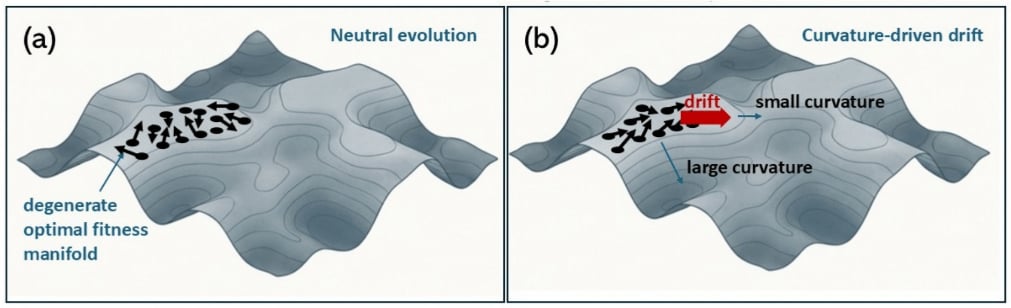
To investigate, the team built a simplified mathematical model to analyze how populations survive on landscapes that are flat and degenerate, factoring in the natural selection and mutation events that would occur in the real world. Further predictions and simulations were then used to test the effects of hundreds of generations of evolution and how they might play out.
What emerged was something different from the randomness hypothesis: when organisms reached the point of maximum fitness, they continued moving along it toward the flattest point, even when there was no fitness advantage. This “directional drift” moves toward areas where a population’s particular traits are better protected against mutations and other disruptions. That is where the survival advantage has an influence—the more forgiving parts of the map.
“On smooth manifolds of equal fitness, an implicit bias appears, directing evolving populations deterministically toward flatter regions,” the researchers write. “This bias emerges from interaction between population variability and landscape geometry.”
Implications for Evolutionary Theory

The researchers point out that there are significant implications for evolutionary theory. Evolving groups can develop robustness and resilience through this directional drift, almost as a side effect, without any specific evolutionary pressure.
The study team also argues that slight biological variations might be more important than previously thought, perhaps revealing the underlying shape of the fitness landscape and how a population has traveled along it through evolutionary history. Previous studies have looked into a similar idea from a slightly different angle through the concept of “mutation-friendly neighborhoods”—safer spaces where genetic variations come with less survival cost.
Future research could potentially link the findings to deep learning systems, where the neural networks that power AI also have a preference for flatter parts of the map. There might also need to be a rethink around how evolutionary change is interpreted by scientists, particularly if it appears to be neutral.
The next steps will be to take the relatively basic models used here and develop them for more complex living organisms and ecosystems, as well as natural variability recorded in the wild.
“Our results highlight a general mechanism by which degeneracy shapes long-term evolutionary outcomes, affecting our interpretation of phenotypic variability, robustness, and neutrality in high-dimensional biological systems,” the researchers write.
The research has been published in PNAS.