Water’s Glassy Secret Revealed: Scientists Observe Liquid-to-Glass Transition in Confined Water
Water covers about 70 percent of Earth’s surface and makes up roughly 60 percent of our bodies by mass, yet it remains scientifically anomalous. At low temperatures, it typically crystallizes into the familiar form of ice. But water can also become “glassy water,” an amorphous, disordered molecular solid. This strange form of water exists in stratospheric clouds in polar regions and helps cold-loving (psychrophilic) organisms avoid ice-crystal damage at extreme temperatures. However, observing water’s transformation from liquid to glass has largely eluded scientists.
When water freezes, it usually forms ice crystals that lock into a rigid, orderly structure. This occurs at temperatures as low as about -45 degrees Celsius (-49 degrees Fahrenheit). Below that lies a poorly understood thermal region scientists call “no man’s land.” Bulk water’s glassy transition was thought to occur around -135 degrees Celsius, but crystalline ice obscured efforts to reach this glassy threshold. In a new study, researchers solved this problem by trapping water in a matrix inspired by nature’s own tricks, and discovered they had been missing water’s glassy transformation all along, hidden in the blur of crystallization.
Trapping Water in a Lipid Matrix

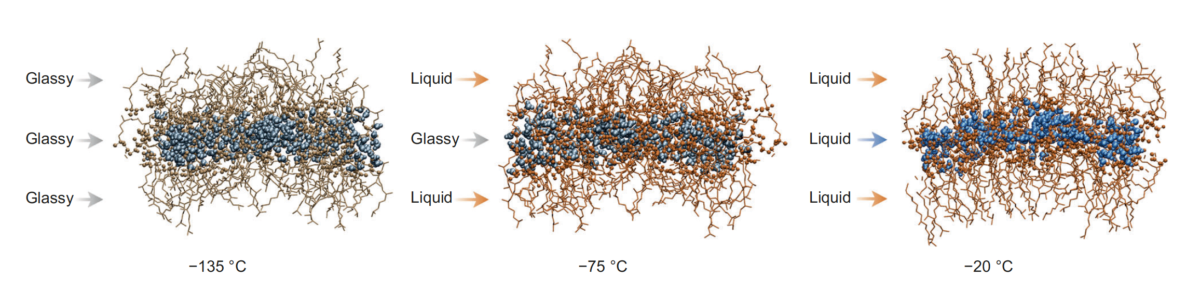
Writing in Nature Communications, physicists locked tiny amounts of water—just a few molecules thick, or less than a billionth of a meter—between two lipid layers made of a special ‘transparent’ type of phytantriol, a fatty alcohol molecule that remains structurally stable and fluid across chilly thermal regimes. Trapped this way, the water was prevented from crystallizing as the temperature dropped, allowing the researchers to track its liquid-to-glass transition in impressive detail.
Surprisingly, they found that this glassy transformation emerges over a much larger—and higher—temperature range than previously thought. To track the behavior of water at sub-nanometer scales, a team of physicists led by Raffaele Mezzenga at ETH Zurich, collaborating with scientists at the Australian Nuclear Science and Technology Organisation (ANSTO), combined computational models with a suite of advanced atomic-probing techniques.
Advanced Techniques Reveal Water's Dynamics
One observational avenue employed ANSTO’s Small Angle and Wide Angle X-ray Scattering (SAXS/WAXS) beamline to map the structure of the water trapped within the lipid matrix at different temperatures, using intensely bright X-rays produced in a synchrotron, or particle accelerator. The team also employed two spectrometers, named Emu and Pelican, at the Australian Centre for Neutron Scattering to detect molecular vibrations and reveal the motion of hydrogen atoms within the sample.
“The neutron signal, detected by our instrument, is dominated by the motions of hydrogen atoms in water,” explains Alice Klapproth, an ANSTO instrument scientist for the Emu spectrometer. “This allows us to selectively measure water dynamics even when the water is confined within a complex soft matrix.”
Altogether, the researchers detected a slowing of the confined water’s dynamics occurring over a surprisingly large range, from -63 to -20 degrees Celsius; a shift they explored across six temporal orders of magnitude, from millionths to just trillionths of a second. Specifically, a dramatic change in molecular dynamics occurs around -35 to -21°C, as the kinetic action of water molecules gets sluggish. And the static glass structural transition occurs between -74 to -64 degrees Celsius, as water becomes locked into a disorganized glassy, solid state.
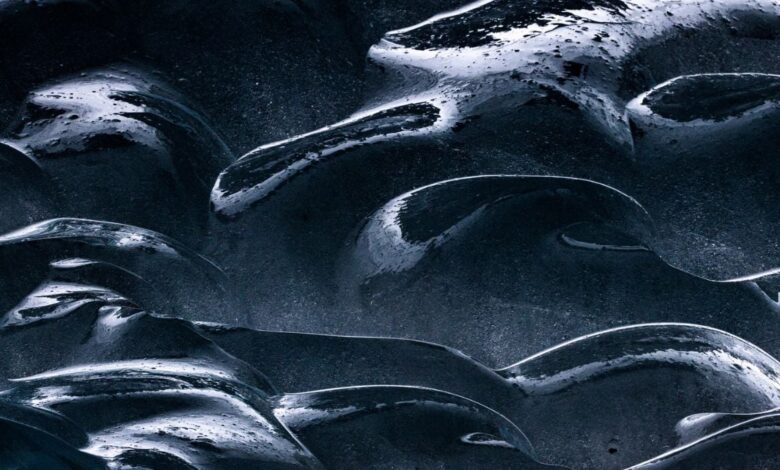
Then, when the mercury really drops, it starts cracking like an icy alien slab of peanut brittle. At very low temperatures, the water and phytantriol sample becomes brittle and starts forming macro- and microscopic cracks.
Implications for Cryopreservation and Food Science
In addition to illuminating the dynamics of an everyday-but-still-enigmatic substance, this research may lead to practical applications. “More generally and beyond the purely fundamental aspects, our findings bear immediate and broader relevance to all physical phenomena involving cryogenic nanoconfined water, such as in the cryopreservation of biological material and deep freezing of food, to name only a couple of examples,” the researchers conclude.
Whether such applications could, however, lead to improvements in restoring preserved tissues or a revolutionary smooth breed of ice cream remains to be seen. This research was published in Nature Communications.