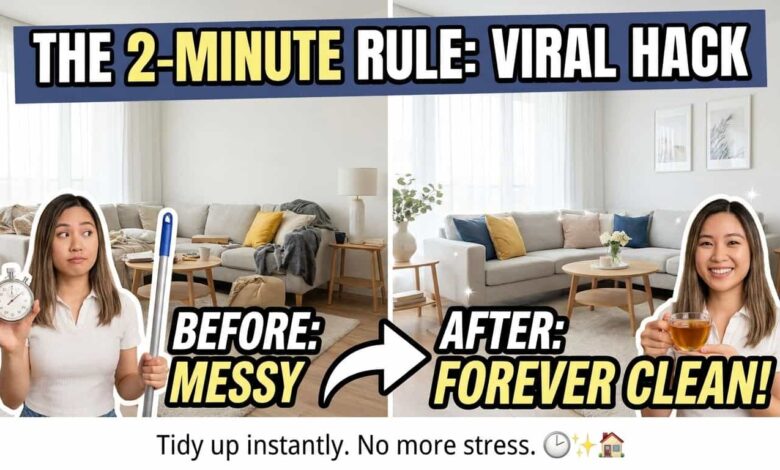
Imagine walking into your kitchen at 7 AM and finding… nothing. No stack of envelopes, no dirty mugs, no scattered mail. Just clear counters.
That doesn’t happen by luck. It happens by frictionless automation.
You don’t need a 3-hour Sunday deep clean. You don’t need a color-coded chore chart. You need a rule so stupidly simple that your brain stops fighting you on it.
Enter the 2-Minute Rule.
If a task takes less than two minutes, you do it immediately. No negotiations. No “later.” No mental lists.
It sounds too easy to work. That’s exactly why it goes viral every single month. Here is how to weaponize this rule to keep your house clean forever.
Why Your House is Messy (It’s Not Laziness)
Before we fix the mess, let’s kill the guilt.
Your house isn’t messy because you are a slob. It’s messy because of Decision Fatigue.
When you see a coat on a chair, your brain doesn’t see a coat. It sees a task. It sees energy expenditure. You think: “I should hang that up, but I need to walk to the closet, open the door, find a hanger…”
That internal dialogue takes longer than the actual task.
The 2-Minute Rule bypasses that negotiation. It interrupts the overthinking loop. It tells your brain: “This is a two-minute job, stop acting like it’s a twenty-minute marathon.”
The Core Concept: “Clutter is Deferred Decisions”
The #1 cause of a messy home is Deferred Decisions.
You take off your shoes. You leave them in the hallway. You have decided to not decide where they go.
The 2-Minute Rule forces immediate action.
-
Took your shoes off? Put them in the rack. (15 seconds).
-
Finished a soda? Rinse the can and recycle it. (20 seconds).
-
Opened the mail? Toss the junk immediately. (10 seconds).
Key Takeaway: Cleaning is not a big event. It is the sum of thousands of tiny, two-minute decisions done correctly.
The 2-Minute Rule in Action (Room by Room)
Don’t just understand the theory. Apply it. Here is exactly how the 2-Minute Rule works in the war zones of your house.
The Kitchen: The Zero-Crumb Counter
The kitchen counter is a clutter magnet. It’s where items go to “rest” before never moving again.
The 2-Minute Playbook:
-
Wipe the counter while the coffee brews. You are standing there anyway. Swipe it.
-
Load the dishwasher immediately. Don’t put a dish in the sink. Put it directly in the dishwasher. It takes the exact same amount of time.
-
Stack mail as it comes in. 90% of mail is junk. Touch it once, toss it, recycle it, done.
If you do this, your kitchen will look “photoshoot ready” 90% of the time.
The Bedroom: The Chair-drobe Killer
Everyone has a chair. That chair grows clothes. We call it the “Chair-drobe.”
The 2-Minute Playbook:
-
When you take off your jeans: You have two choices. Fold them (30 seconds) or hang them (10 seconds). You do not have the choice of draping them on the chair.
-
Make your bed before checking your phone. Pulling up a duvet takes roughly 45 seconds. It instantly makes the room look 80% cleaner.
A bed made with a clear floor visually tricks the brain into feeling organized.
The Bathroom: The Mirror Rule
Bathrooms get gross, but they get gross slowly.
The 2-Minute Playbook:
-
The “Squeegee” Habit: If you spray and wipe the shower door (or tile) immediately after your shower, you will never have to scrub soap scum again. Never.
-
The “Sink Spit” Rule: After brushing your teeth, use the water in your hands to wipe the sink basin edges. It removes toothpaste globs instantly.
Pro Tip: Keep a pack of disinfecting wipes under the sink. While your conditioner sits in your hair for 2 minutes, wipe the counter.
The Psychology of Momentum (The Snowball Effect)
Why does this work “forever”?
Because of Newton’s First Law of Motion: An object in motion stays in motion.
When you complete a 2-minute task, you get a micro-dose of dopamine. It feels good to cross something off.
Here is the magic trick: Don’t stop after one task.
If you put a glass in the dishwasher, you might notice the coffee pot is empty. You might wipe that down too. Before you know it, you’ve cleaned for 5 minutes without realizing it.
But even if you stop after the first 2 minutes? You still won. You are ahead of where you were.
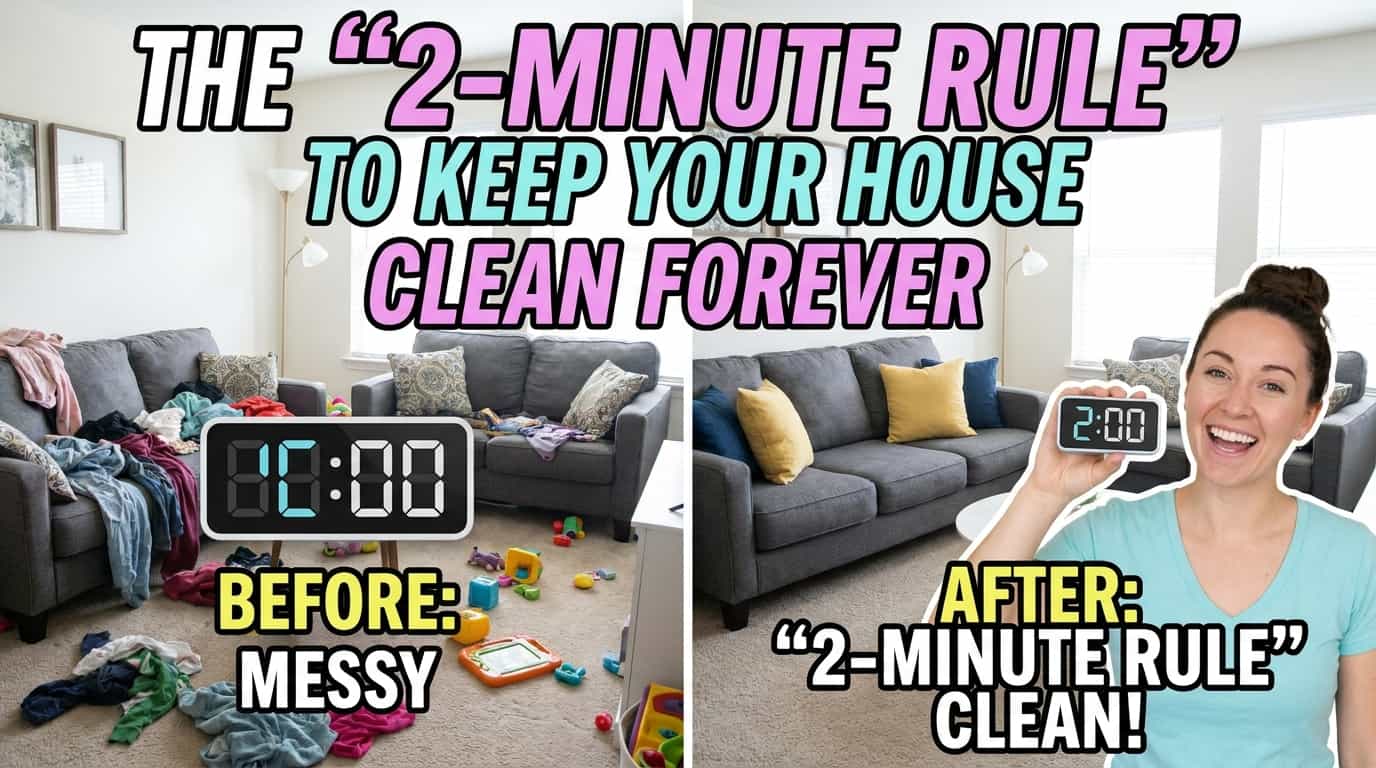
When “Two Minutes” Becomes “Twenty Minutes” (The Trap)
The rule fails when people get too ambitious.
Do not start a 2-minute task that is actually a 20-minute task in disguise.
-
Cleaning out the fridge? That is not a 2-minute task. Do not start it when you are supposed to be leaving for work.
-
Organizing the Tupperware drawer? That is a Saturday project.
The 2-Minute Rule is for micro-tasks, not projects.
The Golden Rule: If it takes longer than 2 minutes, you don’t do it right now. You schedule it. Or you write it down. But you don’t let the “big task” block you from doing the “small tasks.”
How to Make it Stick Forever
Consistency beats intensity. Here is how to hardwire this habit into your DNA:
-
Set a visual cue: Put a post-it note on your nightstand or fridge that just says “2-Minute Pickup.”
-
Attach it to an existing habit: Every time you leave a room, look back at the room from the doorway. Do you see anything you can grab and put away on your way out?
-
Get the family on board: Make it a game. “Everyone has to do 5 two-minute tasks before dinner.” It’s fast, painless, and solves the roommate/spouse resentment problem.
Conclusion: Stop Cleaning, Start Maintaining
The secret to a clean house is not hard work. It is high frequency, low effort.
You aren’t “cleaning the house.” You are resetting your environment. You are treating your home like a hotel room that gets serviced every single day for two minutes at a time.
Try it for just 48 hours. Commit to never leaving a room empty-handed. Do the thing immediately.
Your future self, sitting in that clean living room with a glass of wine, will wonder why you didn’t learn this trick ten years ago.
Now, I want to hear from you: What is the one “clutter hotspot” in your house that constantly defeats you? Drop it in the comments below — and if this trick saved your sanity, share this article with a messy friend who needs a reality check.