
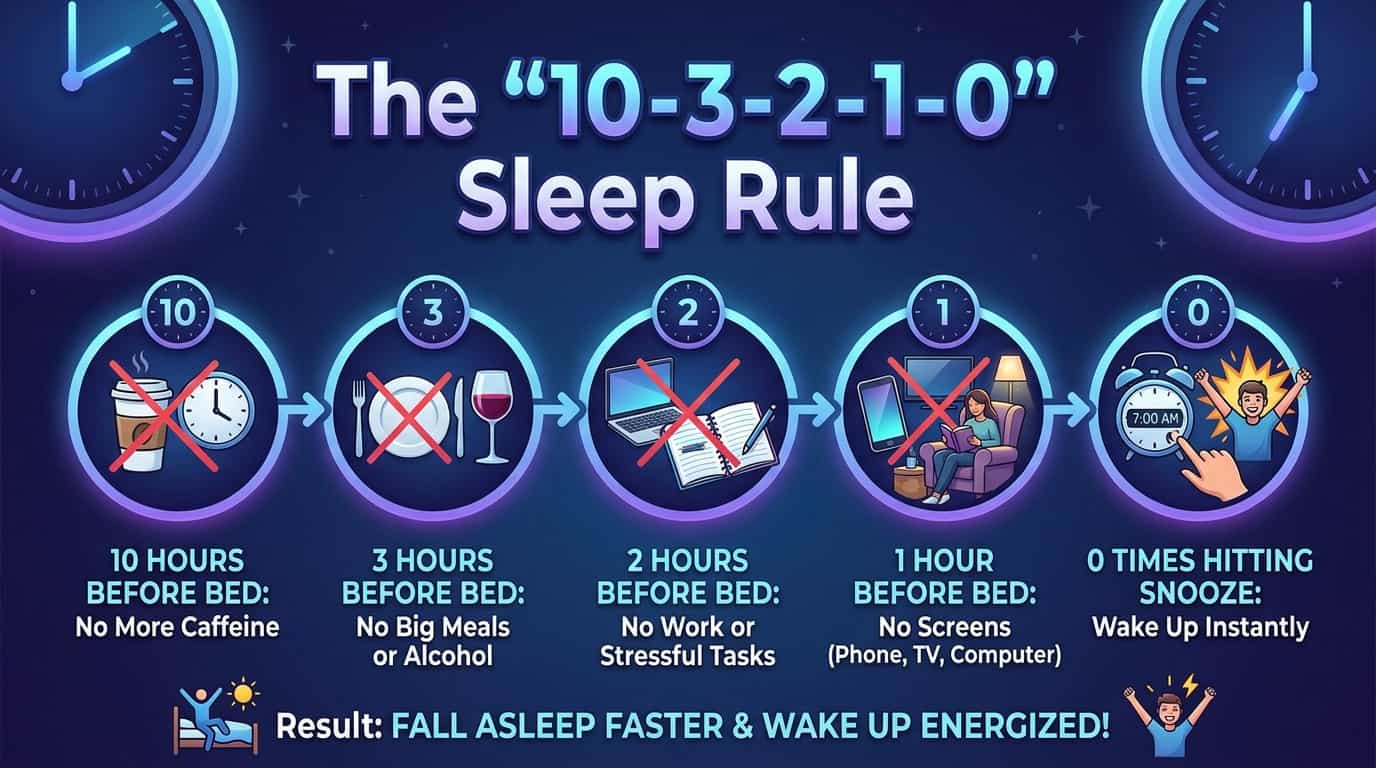
2 Hours Before Bed: No More Work or Stimulating Activity
Stop touching your to-do list.
If you are answering emails, checking your bank account, or having a stressful conversation with your partner about mortgage rates right before bed, your brain is flooded with cortisol (the stress hormone). Cortisol is the arch-nemesis of melatonin (the sleep hormone).
You cannot expect to sprint a marathon and then suddenly sit in a meditative trance two minutes later. You need a runway.
-
The Rule: Shut the laptop, silence the Slack notifications, and end all “problem-solving” tasks two hours before bed.
-
The Solution: Engage in “low-stakes” activities. Read fiction, do light stretching, listen to a podcast, or tidy the living room.
-
Key Takeaway: A racing mind cannot sleep. Give yourself a mandatory transition period between “doing mode” and “being mode.”
1 Hour Before Bed: No More Screens
Your phone is a sunrise in your pocket.
This is the hardest rule to follow, and the most effective. The blue light emitted from your phone, tablet, and TV suppresses the production of melatonin by up to 50%. Scrolling through social media—watching curated highlight reels of everyone else’s lives—also triggers dopamine spikes and anxiety.
Do not just set your phone to “Night Shift.” The content itself is too stimulating.
-
The Rule: Zero screens for the final 60 minutes.
-
The Alternative: This is the time for the analog. Take a hot bath or shower (the drop in body temperature afterward signals the brain to sleep). Write in a journal to “brain dump” your worries. Practice 4-7-8 breathing (inhale 4 seconds, hold 7, exhale 8).
-
Key Takeaway: Blue light delays your biological night. If you win this hour, you win the morning.
0: The Number of Times You Hit the Snooze Button
Zero. Never. Ever.
When your alarm goes off at 6:30 AM, and you smash the snooze button to sleep until 6:45 AM, you are not getting “15 extra minutes of good sleep.” You are starting a brand new sleep cycle that you will violently interrupt in 10 minutes.
This causes sleep inertia—that groggy, drunk-like feeling that can last for up to four hours after you wake up.
-
The Rule: Set one alarm. Put it across the room if you have to. When it goes off, you stand up. No negotiation.
-
The Strategy: If you struggle with this, use an alarm clock that simulates sunrise rather than a jarring phone tone.
-
Key Takeaway: Snoozing is the first failure of the day. By getting up immediately, you anchor your sleep schedule, which makes falling asleep the next night easier.
The Bottom Line
The 10-3-2-1-0 rule isn’t about deprivation; it’s about boundary-setting. It is a timeline designed to align your behavior with your biology. You don’t need a $5,000 smart mattress or exotic supplements. You just need to count backward.
Try this countdown tonight. You have nothing to lose except the bags under your eyes.
Have you tried this method, or are you currently guilty of breaking one of these rules right now while reading this in bed? Drop your score from 0-10 in the comments below and let us know which hour is the hardest for you to resist.