
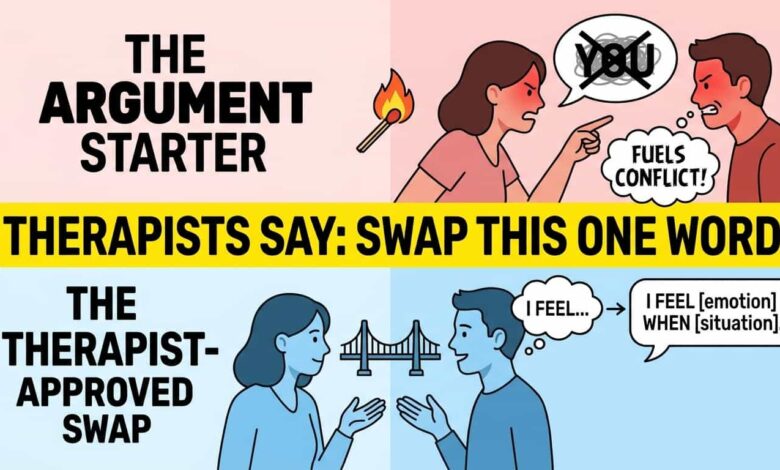
You feel your blood pressure rising. Your partner leaves the dishes in the sink again. You open your mouth, ready to solve the problem, but the second you speak, the conversation detonates into a screaming match. You didn’t mean to start a war. But you used the word.
According to couples therapists and conflict-resolution experts, there is one word that acts like gasoline on a fire. It shuts down the logical brain of the person you are talking to and instantly triggers their defense mechanisms. That word is: “You.”
Why “You” Is the Nuclear Button of Arguments
It sounds harmless. It’s a pronoun. But in the context of a disagreement, “You” is almost always followed by an accusation. Think about it. When you’re frustrated, “You” is the launchpad for blame.
“You never listen to me.” “You always leave a mess.” “You don’t care about my feelings.”
Dr. John Gottman, a leading researcher on relationship stability, identifies this as part of a “Harsh Start-Up.” When you begin a sentence with “You,” the listener hears an attack, not a complaint. They stop listening to your pain and start preparing their legal defense.
The Psychology of Defensiveness
When you say “You did this,” the other person’s amygdala (the fight-or-flight center of the brain) perceives a threat. They will either:
- Fight: “Oh yeah? Well, you are always working late!”
- Freeze: They shut down and stonewall you.
- Flee: They walk out of the room.
Nobody is solving the dishes problem. You’re just fighting about who is the worse person.
The “I Feel” Phenomenon: Why It Works
The antidote to the toxic “You” is taking radical ownership of your own emotional state. This is often called using “I Statements.” This isn’t just pop psychology; it’s a neural hack. When you start a sentence with “I,” you are not attacking their character. You are revealing your reality. The listener doesn’t need to defend themselves against how you feel; they just need to listen.
5 Phrases to Say Instead of “You Always/Never”
Here is exactly how to rewire your language to stop the fight and start the conversation.
1. Swap: “You never listen.”
Say This Instead: “I feel unheard right now. I need to know you understand my point of view.”
Why it works: You are naming the emotion (unheard) rather than labeling their behavior (never listening). It invites empathy rather than defensiveness.
2. Swap: “You are so messy.”
Say This Instead: “I get anxious when the kitchen is cluttered. I would appreciate it if we could clean up together tonight.”
Why it works: You are owning the anxiety (your trigger) and proposing a team solution. It’s you two versus the mess, not you versus them.
3. Swap: “You’re always on your phone.”
Say This Instead: “I miss connecting with you. Can we put our phones away for the next hour and just talk?”
Why it works: You are exposing a vulnerable need (connection) rather than criticizing their behavior (phone usage). Vulnerability breaks down walls.
4. Swap: “You don’t care about me.”
Say This Instead: “I’m feeling disconnected and I need some reassurance or quality time. Can we plan a date night?”
Why it works: Assuming they don’t care is a mind-read. Telling them you need reassurance gives them a clear roadmap to fix the problem.
5. Swap: “You are wrong.”
Say This Instead: “I see this differently. Can you help me understand your perspective?”
Why it works: Saying “you are wrong” is a dead end. Saying “I see it differently” acknowledges that two truths can exist in the same room. It shifts the goal from winning to understanding.
The Exception to the Rule: When “I” Becomes Manipulative
Be careful. You can’t just slap an “I” on a criticism and call it healthy.
- Bad: “I feel like you are an idiot.”
- Good: “I feel scared when we drive this fast.”
If your “I feel” statement is followed by “like you” or “that you,” it’s just a disguised “You” statement. Keep it strictly about your emotion (sad, angry, scared, happy) and the specific situation.
How to Implement This When You’re Furious
It is almost impossible to remember communication skills when your heart rate is above 100 BPM. Therapists call this “Flooding.” If you try to use an “I statement” but you’re seeing red, it will sound sarcastic and fail.
- Press Pause: Say, “I’m too angry to be productive right now. I love you, but I need 20 minutes to calm down so I don’t say something I regret.”
- Self-Soothe: Go for a walk, wash your face, breathe. Do not sit and stew about how right you are.
- Return and Repair: Come back and use the “I feel” formula.
The Takeaway
Words are either weapons or bridges. The word “You,” when used as an accusation, forces the person you love to become your enemy. By shifting your language to focus on your own feelings and needs, you give them the opportunity to be your ally.
Mastering this one tiny grammar swap won’t just save your relationship; it will change how you negotiate at work and interact with your friends.
Ready to try it? Think about your last big argument. How would you rewrite your opening sentence using an “I Feel” statement instead of a “You” statement? Drop your translation in the comments below — let’s see if we can turn the fights into fixes.