Stop scrolling. Look at this equation.
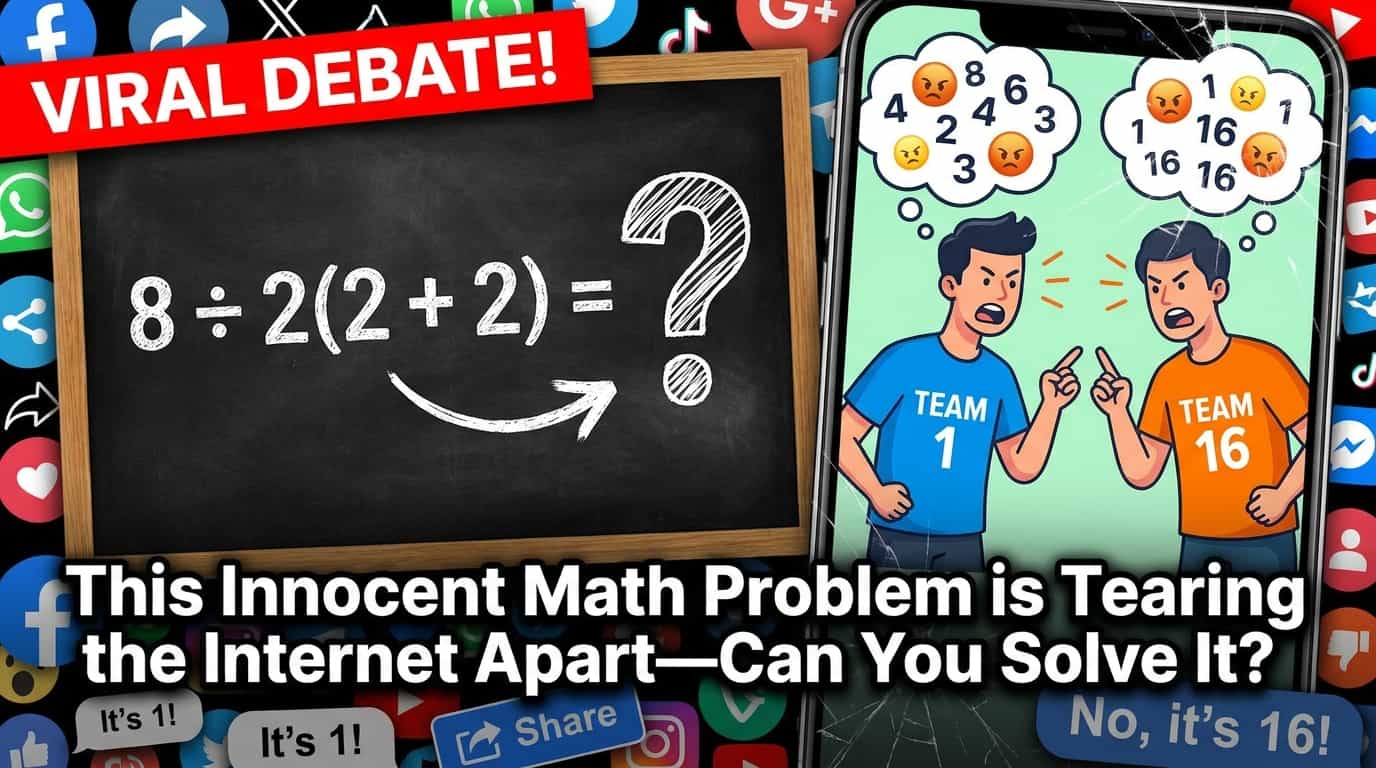
8 ÷ 2(2+2) = ?
If your brain just short-circuited, you’re not alone. This seemingly simple math problem has sparked a civil war on social media, leaving mathematicians, engineers, and everyday people screaming at their screens. Are you Team 1 or Team 16? Because one of you is wrong—and the reason why is driving the internet insane.
The Viral Equation: Why Your Brain is Glitching
The controversy isn’t about math ability. It’s about how you were taught to read a sentence.
This equation perfectly exploits a generational and geographical divide in the “Order of Operations.” You probably learned “PEMDAS” (Please Excuse My Dear Aunt Sally) or “BODMAS.” But here’s the catch: many people misinterpret the “M” and “D” relationship.
Here is why this is breaking group chats.
Method 1: The “Old School” Approach (Answer = 1)
If you solved the equation and got 1, you likely treated the expression 2(2+2) as a single, unified entity. You probably did this:
-
Parentheses first: (2+2) = 4.
-
Multiplication (Implied): 2(4) = 8.
-
Division last: 8 ÷ 8 = 1.
People who get 1 generally believe that the lack of an explicit multiplication sign (×) between the 2 and the parenthesis creates an “implied multiplication” that takes priority. To them, it reads like 8 / (2(2+2)).
Method 2: The “Modern Calculator” Approach (Answer = 16)
If you got 16, you are following the strict, modern programming logic used by Google, Wolfram Alpha, and most modern calculators. Here is your logic:
-
Parentheses first: (2+2) = 4.
-
Left to Right Rule: Once the parentheses are solved, you move left to right.
-
Division first: 8 ÷ 2 = 4.
-
Multiplication: 4 × 4 = 16.
In this method, 2(4) is treated exactly the same as 2 × 4. Therefore, because division comes before multiplication when reading left to right, the answer is 16.
What is the Actual Correct Answer?
Technically, the answer is 16.
Here is the cold, hard truth according to modern mathematical convention. The order of operations states that multiplication and division hold equal rank. When you have operations of the same rank, you must solve them from left to right.
The Rule:
Division is just multiplication by a reciprocal.
8 ÷ 2(4) is the same as 8 ÷ 2 × 4.
If you do it left to right, you get 16.
However, the reason the internet is losing its mind is that the equation is deliberately written badly.
Why The Internet is Fighting (And Why You Can’t Look Away)
The virality of this problem isn’t about calculus; it’s about ego and ambiguity.
-
The “Gotcha” Factor: No professional mathematician would ever write an equation this way. It lacks clarity. But seeing people confidently call others “idiots” for getting 1 (or 16) triggers a deep psychological need to defend your education.
-
Generational Warfare: Gen X and Millennials who learned math in the 80s and 90s often swear by the “implied multiplication” rule (Answer = 1). Gen Z and anyone using modern coding languages like Python or Java adhere to the strict left-to-right rule (Answer = 16).
-
The Smartphone Effect: Pick up your iPhone and type it in. You get 16. Ask an older Casio calculator? It might say 1. The tools we use are divided on the syntax.
The Final Verdict: How to Win the Argument
If you want to sound like the smartest person in the room (or in the comments section), here is your script:
-
Technically, 16 is the correct answer based on the current academic consensus and the left-to-right rule for equal precedence.
-
However, 1 is a valid human interpretation because the notation is ambiguous and poorly formatted.
-
The real answer is: The question is flawed.
Key Takeaway:
Stop arguing about the answer. Start agreeing that the person who wrote the equation should have used more parentheses.
Can You Solve This One?
Now that you know the secret, let’s test your brain one more time. This one is slightly different but causes just as much chaos:
What is 6 ÷ 2(1+2)?
-
A) 1
-
B) 9
Type your answer in the comments below, but be nice—you might end up in a fight with your aunt before dinner is over. Share this with someone who claims they are “good at math” and see which side they take.