Can a small label steer fast-food customers toward lower-carbon meals? New research published in JAMA Network Open suggests it can. In an online randomized clinical trial with more than 10,000 US adults, simple climate labels on a simulated fast-food menu modestly reduced the share of orders classified as having a high climate impact—and did not appear to worsen the nutritional quality of those orders.
How the Study Worked
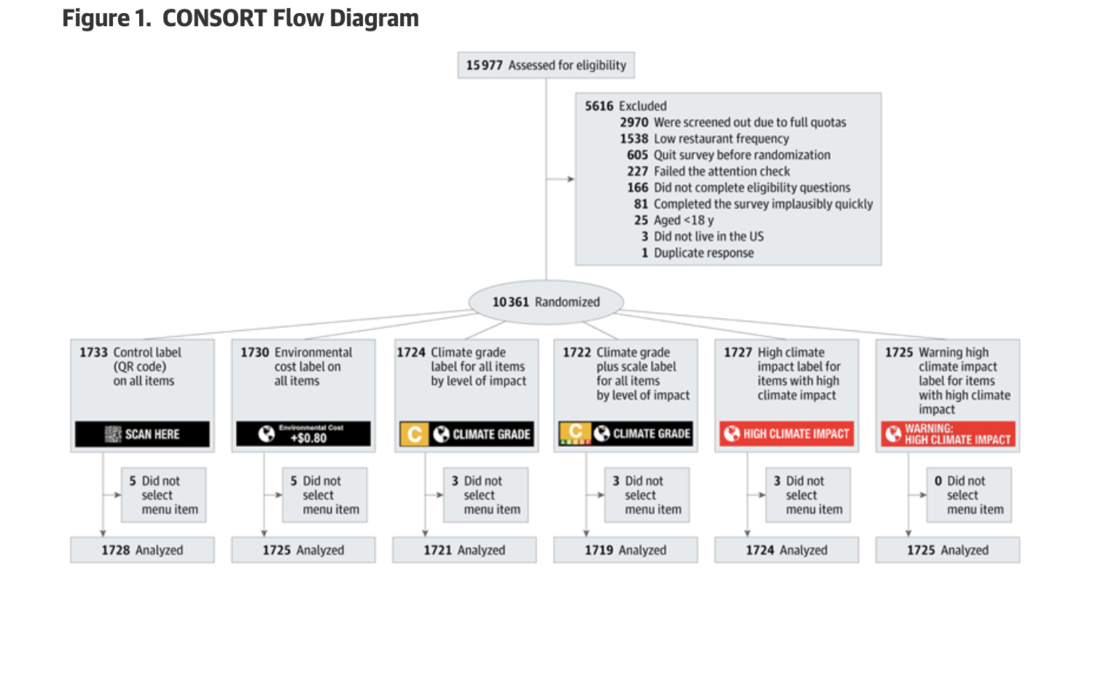
The researchers recruited over 10,000 US adults and used quota sampling to build a group broadly representative of the US population by gender, race, ethnicity, age, and education. Participants ordered from a 16-item menu modeled on a popular US fast-food chain, featuring beef burgers, chicken, fish, salads, and a plant-based burger.
Each participant was randomly assigned to see one of six label types alongside the menu items:
- A QR code only (the control group)
- An environmental “cost” in dollars
- A climate grade
- A climate grade plus a scale showing all possible grades
- A “high climate impact” label on high-greenhouse-gas-emission items only
- A “warning high climate impact” label
The central question was straightforward: if people knew which foods had the biggest climate footprints, would they choose differently?
What the Labels Changed
They did—at least somewhat. In the control group, which saw only a QR code with no climate information, 53 percent of participants selected an item classified as having a high climate impact. That figure dropped to 48 percent among those who saw a climate grade, 46 percent for a climate grade plus a scale, 45 percent for a high-climate-impact label, and 47 percent for a warning label. The environmental cost group came in at 49 percent, which was not significantly different from the control.
Two labels stood out for their effect: the climate grade plus scale and the simple “high climate impact” label. However, the researchers noted that the differences between label types were so small that they were minor.
No Trade-Off With Nutrition

The team also investigated whether choosing a more eco-friendly option led people to pick less-healthy foods. That did not appear to be the case. Overall, the groups did not differ significantly in Nutrient Profile Index scores, a measure that includes calories, saturated fat, sodium, sugar, fruits, vegetables, nuts, and fiber.
Why Some Labels Worked Better

Although all the labels conveyed roughly the same information, their outcomes varied. The environmental cost label translated emissions into a dollar amount but did not clearly indicate whether that number was good or bad, and it appeared in a smaller black-and-white font—so it may have been easy to ignore. The most effective labels were the easiest to read and understand. The researchers noted that previous nutrition-label research suggests additional context can aid interpretation, and grade scales have been used in other food-labeling schemes.
The study also found that the climate grade and high-climate-impact labels were more effective at reducing high-impact selections among participants who had expressed greater concern about climate change beforehand. The effects did not vary by age, gender, or political affiliation.
Important Limitations

There is a significant catch: no one was actually standing in a fast-food restaurant, hungry and deciding what to eat, and there were no real monetary costs to consider. The study was conducted online, participants selected just one entrée, and the emissions associated with menu items were estimates. The menu was based on a single fast-food chain and offered a relatively limited range of foods. A climate label that changes someone’s choice on a screen may not have exactly the same effect in the real world.
Still, the researchers say the relatively small reductions seen in individual choices could add up. “This randomized clinical trial’s findings suggest that using climate labels on restaurant menus, particularly climate grade plus scale designs, may decrease climate impact and improve nutrition of restaurant orders,” the study authors conclude.
About a third of US adults eat fast food on a given day, according to recent national data, so even these small labeling-driven changes could mean millions of higher-impact meals avoided each day.
After all, most of us aren’t going to calculate the carbon footprint of our lunch before ordering it—or even know how to do that if we wanted to. But if someone else does the math and provides simple guidance, we might just make a different choice.